Quantum Momentum 2.0: What the latest signals say about the market


 Back to top
For years, quantum computing was a market of roadmaps: scientific milestones, hardware targets and promises of future commercial advantage. That is beginning to change.

Across research, funding, talent, infrastructure, company formation and early commercial activity, the signals are becoming harder to ignore. The question is shifting from whether the market is forming to how far it has actually progressed, and where durable businesses are beginning to emerge.
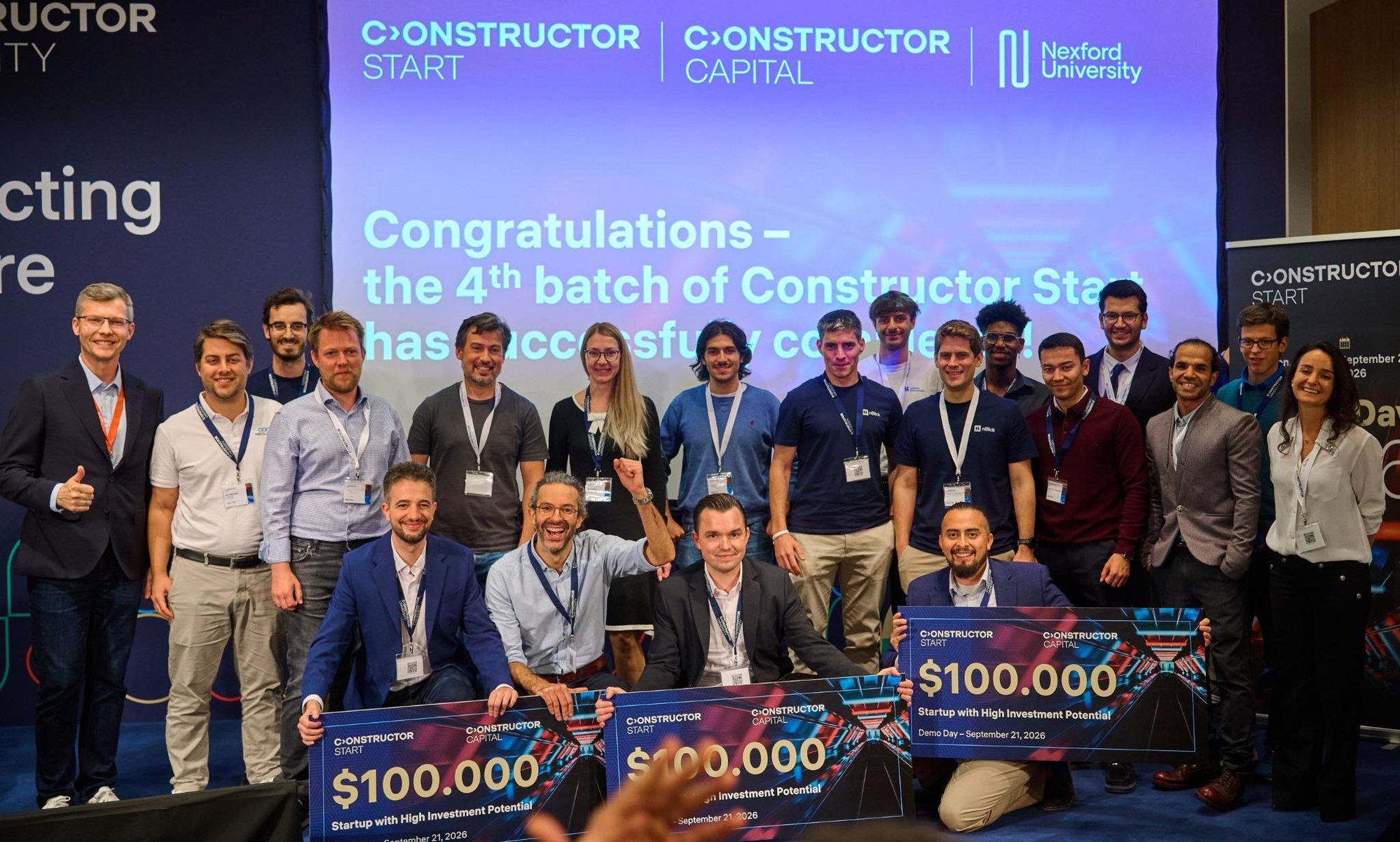
That was the question Constructor Capital General Partner Marie Lepske revisited at the latest Constructor Start Demo Day at Constructor University in Bremen.
In Quantum Momentum 2.0, she looked beyond individual company announcements and technology roadmaps, examining a broader set of indicators across the whole quantum ecosystem. Her thesis was deliberately simple:
“Today I will show you one thing: the momentum, not promises, actual signals that this market has crossed an inflection point.”
The interesting part that we want to share is what those signals reveal when viewed together.

From research momentum to market formation
The first signs are visible in science itself.
Quantum-related publications and patent filings have expanded significantly over the past two decades, while competition between the US, China and Europe has intensified.

But volume alone says relatively little about where the most consequential breakthroughs will emerge. Research quality and progress toward systems that can operate reliably at scale matter way more.
That shift is more visible in fault-tolerant quantum computing. New approaches to error correction are reducing the theoretical overhead required to build useful systems, while industry roadmaps are moving toward logical rather than physical qubits as the more meaningful measure of progress.
As Marie Lepske put it:
“Every company has a road map. What matters is what has been demonstrated against it.”
The distinction is becoming increasingly important. Many vendors now point to fault-tolerant systems toward the end of the decade, but the distance between current capability and those targets varies widely. As roadmaps begin to converge, demonstrated progress becomes more informative than the ambition of the promise itself.
Capital is moving beyond venture funding
The financing environment around quantum has also become broader.
Venture capital remains part of the picture, but corporate investment, public markets and multi-year government commitments are now supporting different layers of the industry. That capital is not only funding quantum-computing companies. It is also paying for laboratories, research programs, infrastructure and the talent base required to support a larger market.
Marie also stressed the broader requirement:
“You need the full ecosystem, education, workforce, infrastructure, and software and manufacturers.”
That ecosystem is expanding. Dedicated quantum education programs have multiplied, demand for specialist skills has risen, and more companies are building processors, control systems and other enabling technologies. Testbeds and quantum-network infrastructure are also becoming more common.
This matters because the transition from research field to industry depends on more than technical breakthroughs. A functioning market also needs engineers who can build the systems, customers willing to experiment with them, suppliers that can support production and investors prepared to finance development cycles that remain unusually long.
Commercial signals are appearing
Revenue is beginning to provide another piece of evidence.
Quantum computing crossed $1 billion in annual revenue in 2025, according to the figures used in the presentation, up from roughly $700 million the year before. That revenue spans hardware sales, cloud access to quantum processors, software, consulting and integration, as well as the classical control equipment required to operate quantum systems.

The number is meaningful, but it needs context.
On commercialization, Marie Lepske added an important caveat:
“I want to be more honest: most of this is still explorational revenue, companies paying to learn, to pilot, to understand the technology. The quantum advantage revenue is still ahead, but the commercial pipeline is real and growing at over 40% per year.”
In other words, customer spending is no longer hypothetical. Organizations are paying to access systems and understand where quantum may fit into future workloads. What has not yet been established at scale is sustained revenue based on applications where quantum offers a clear advantage over classical alternatives.
Public markets show a similar mix of progress and uncertainty. More quantum companies have reached public markets, giving the sector greater access to capital and visibility. At the same time, volatile post-listing valuations are a reminder that headline market capitalization is not the same thing as technical execution or commercial validation.
The full Quantum Momentum 2.0 presentation goes further into capital flows, public-market activity, valuations and the roadmaps of individual quantum companies. Watch Marie’s full presentation on YouTube:
Momentum is not the same as maturity
Taken together, the signals point to a market that looks very different from a few years ago.
Scientific output is expanding. More capital is available from more sources. Talent and infrastructure are growing. Companies are reaching public markets, and commercial revenue has begun to emerge. Yet the most important technological question remains unresolved.
Fault-tolerant roadmaps continue to advance, but broad commercial use is still ahead. Classical GPUs are improving at the same time, while photonic, neuromorphic and other computing architectures are progressing in parallel.
For us, this is one of the most interesting question now. The momentum around quantum is no longer hard to see, we see it in the science, in the capital coming into the sector, and in the conversations we are having with founders, investors and industry partners. What we are discussing much more often now is where that momentum is actually becoming investable: where scientific progress, infrastructure and real customer demand are starting to reinforce each other strongly enough to support durable companies.
That is where the next phase of the market will be decided: not by momentum alone, but by which companies can turn scientific advantage into demonstrated capability, customer adoption and commercial value.
Constructor Capital is built for that stage of the market. We understand the science, stay close to where new technology is being created, and know what it takes to turn technical advantage into a global company. We are actively looking for the teams capable of doing exactly that.